
Security Minister statement on national security and threat level
The Security Minister gave an update to Parliament on a number of recent national security issues, including the increase in the national threat level
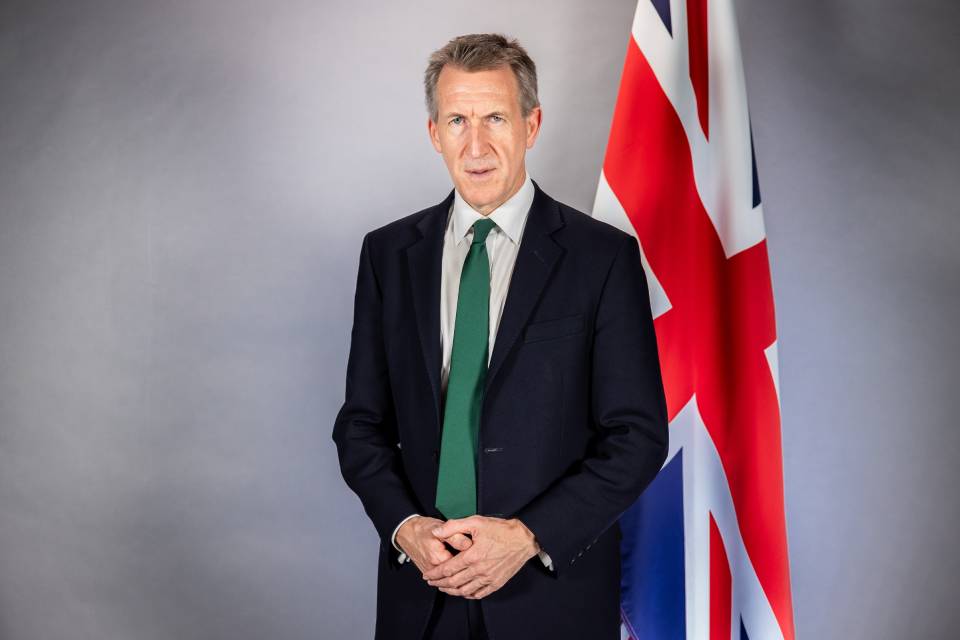
With permission, Mr Speaker, I will make a statement on recent national security developments, including the increase in the national terrorism threat level.
The events of the last few weeks have illustrated the breadth and seriousness of the national security threats that we face, from both terrorists and foreign states.
In responding to these threats, they have also highlighted the strength and resilience of our world leading law enforcement and intelligence agencies.
Over recent weeks we have seen…
A series of arson attacks and incidents against British Jews and opponents of the Iranian regime, including the horrifying terror attack in Golders Green, which seriously injured two members of the Jewish community.
We’ve seen the recent conviction of a 21-year-old man who planned to commit a terrorist attack to further his extreme white supremacist agenda.
And convictions last week against two individuals under the National Security Act for surveilling and intimidating dissidents on behalf of China.
And we are seeing record levels of investigative casework on terror plots, espionage, and state-linked threats to individuals.
Mr Speaker, on 30 April, the Joint Terrorism Analysis Centre (JTAC) raised the UK national terrorism threat level from ‘substantial’ to ‘severe’. The decision to change the UK’s terrorism threat level is taken independently of ministers, based on the very latest intelligence.
‘Severe’ means that a terrorist attack is highly likely in the next six months. The threat level was last at severe from November 2021 until February 2022.
This increase in the threat from terrorism follows the recent stabbing attack in Golders Green, but it is not solely as a result of that attack.
The terrorism threat in the UK has been gradually increasing. It is driven primarily by the broader Islamist and extreme right wing terrorist threat from individuals and small groups based here in the UK.
While the UK national threat level reflects JTAC’s assessment of the terrorist threat in the UK, it comes against a backdrop of increased state-linked physical threats which is encouraging acts of violence, including against the Jewish community.
In response, we have announced £25 million of immediate funding to strengthen policing, protect Jewish communities and provide reassurance.
This brings the total protective security funding to £58 million this year – the largest investment a government has made in protecting Jewish communities.
Now Mr Speaker, I have also initiated a review of the national threat level system, which currently captures only the threat from terrorism, to ensure that it remains fully relevant, and that we are communicating as clearly as possible with the public about the national security threats that we face today.
Mr Speaker, CONTEST, the government’s counter-terrorism strategy, sets out a clear framework – Prevent, Pursue, Protect and Prepare – which aims to ensure people can go about their lives freely and with confidence.
We are broadening our intervention capabilities to better support those at risk of being drawn into terrorism through the PREVENT programme.
We have improved training and guidance for frontline professionals and practitioners to better spot the signs of radicalisation.
And we are working with technology companies, international partners and Ofcom to tackle online content used to radicalise, recruit and incite terrorism.
Coordinated intervention is crucial to reduce the terrorist risk. So we are providing children and individuals with the right support with our Interventions Centre of Expertise, which brings together MI5 and Counter Terrorism Policing with expertise from wider public services.
MI5 and CT Police work tirelessly to stop terrorist attacks, with 19 late-stage attack plots disrupted since 2020 including a chilling ISIS-inspired plot to target Jewish communities in Manchester using firearms.
We have delivered our manifesto commitment to improve the security of public events and venues across the UK through Martyn’s Law, and free expert advice, guidance and training is available to owners and operators of venues and public spaces through the ProtectUK website.
Through closer working across the emergency services, we are maintaining strong, multi-agency working capabilities to respond to a range of different scenarios. We keep our preparedness under constant review, and the response is exercised regularly, ensuring that our emergency services can respond immediately to terror attacks – as we saw in their brave response to the violent antisemitic attack in Golders Green.
Now Mr Speaker, terrorism and state threats are sometimes interrelated, as we have seen with threats from states such as Iran, and the wider use of both terrorist groups and proxies by state actors including Russia.
We face a sophisticated and persistent challenge in responding to China, which presents a unique set of threats to the United Kingdom.
The case last week demonstrates that we have the tools to successfully respond to that challenge.
And Members of this House will know that a jury delivered its verdict following the nine-week trial of Bill Yuen and Peter Wai.
The jury found both individuals guilty of assisting a foreign intelligence service – which, in this case, was the Hong Kong Police Force – this was done under the National Security Act. Wai was also found guilty of misconduct in public office.
The verdict represents the first convictions under the National Security Act related to China – and sends a strong message that the full force of the law will be applied to anyone who carries out hostile acts in the UK on behalf of any foreign state.
Both individuals held positions of power, leveraging these to conduct hostile activity on UK soil on behalf of China. It is simply unacceptable that an employee of a foreign power was conducting a shadow policing operation in the United Kingdom.
That is why the Chinese Ambassador has been summoned, and the Foreign Secretary will be making clear to Hong Kong’s Chief Executive that this type of activity was, and will always be, unacceptable in the United Kingdom. The Foreign Office have also made it clear that Yuen’s employment at the Hong Kong Economic Trade Office must be terminated immediately.
Now Mr Speaker, this trial has understandably caused considerable concern within the UK amongst the Hong Kong community.
The safety and security of Hong Kongers in the UK is paramount. That is why my officials have been working closely with the National Security Protective Authority, to deliver new guidance on transnational repression. This guidance provides examples of what transnational repression might look like and what to do if anyone feels under threat from any state.
Transnational repression from China however, is just one type of state threat activity. That is why the government is taking decisive action across a much broader range of state threats.
We are…
Rolling out new training for police officers and staff to increase their understanding of state threats.
Driving forward the Counter-Political Interference and Espionage Plan to protect the UK’s democratic institutions and processes.
Bringing forward fast-track legislation in the coming weeks which will clamp down on individuals and groups carrying out hostile activity for foreign states, including those who act as their proxies. This legislation will include new proscription-like powers to ban the activities of state-backed organisations who pose a threat to the UK’s national security.
And we are implementing all the recommendations made last year by Jonathan Hall KC, the Independent Reviewer of State Threats Legislation.
So we are responding to state threats in all their forms.
Now Mr Speaker, national security is the first duty of government. As this House knows, that duty includes being able to respond to a range of threats.
So we are giving our police and intelligence services the resources they need for that vital role. Last year we provided an extra £140 million for Counter Terrorism Policing, plus nearly £600 million more for our intelligence services. This takes their funding to record levels.
And Mr Speaker, protecting our communities and standing up to hatred and intolerance is a shared responsibility of every person in the UK.
So I urge the public to remain vigilant and report any concerns they have to the police. Their contribution is a vital part of our efforts to keep our country safe.
And Mr Speaker, support to the victims of terrorism is a moral duty, and I would like to acknowledge the profound and enduring impact on the survivors and families of those affected by Golders Green, and all terrorist attacks, whose lives have been forever changed.
I want to close by thanking those individuals serving in our police and security services for their dedication to keeping our country safe, and the public for their continued vigilance. We owe them all a debt of gratitude.
Mr Speaker, I commend this statement to the House.
From: Home Office and Dan Jarvis MBE MP